
Home › Data Analyst vs Business Analyst
Data analyst vs business analyst: which role is actually for you?
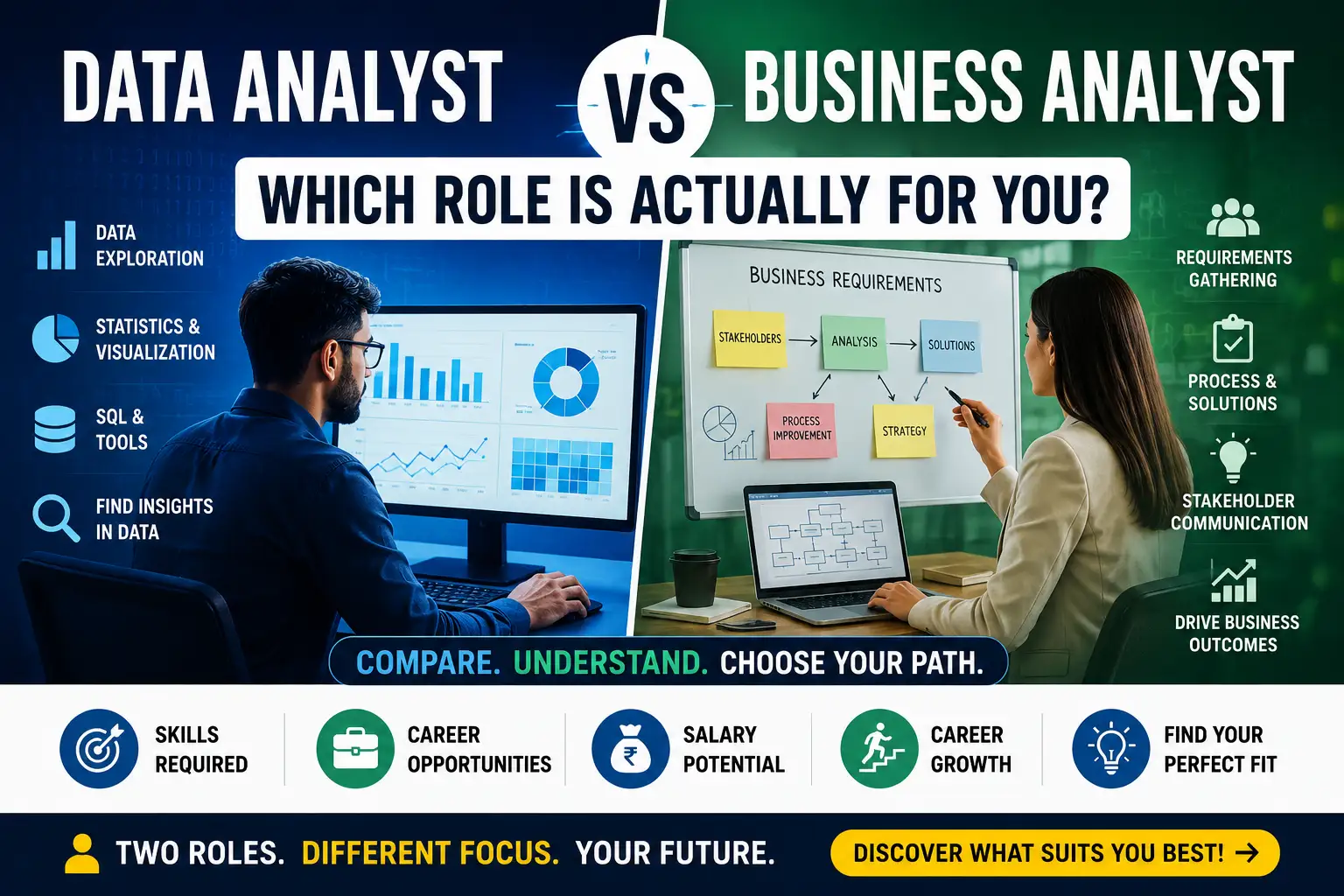
Business analysts earn more on average in India. That fact sends a lot of people down the wrong path, because the premium is largely buying a different job — not a better-paid version of the same one.
The short answer
Do you want to work with the data itself? Data analyst. You will spend your day in SQL, spreadsheets and dashboards.
Do you want to work with the people who use it? Business analyst. You will spend your day in meetings, documents and trade-offs.
Do you just want the better-paid one? Read the salary section before you decide — the gap is real but it is smaller and more explainable than it looks.
What each one does on a Tuesday
Data analyst
A question arrives — why did enrolments drop in June, which products are returned most, where is the process losing time. You find the data, work out whether you can trust it, join it to whatever else it needs, and produce an answer somebody can act on. Then you usually discover the data was messier than anyone said, and half your day goes on that instead.
Business analyst
A problem arrives — a team wants a new system, a process is failing, two departments disagree about what "customer" means. You talk to everybody involved, work out what is actually needed as opposed to what was asked for, write it down precisely enough for developers to build from, and stay involved while they do. Much of the value is in the interviewing and the writing.
The distinction most articles miss. A data analyst is usually asked what happened. A business analyst is usually asked what should we do about it. Both need to understand the business; only one of them spends the day with the data.
Side by side
| Data analyst | Business analyst | |
|---|---|---|
| Core question | What happened, and is the number right? | What should we change, and what exactly gets built? |
| Daily tools | SQL, Excel, Power BI or Tableau, sometimes Python | Excel, documents, process maps, JIRA or similar |
| Output | A dashboard, a query, an answer with caveats | A requirements document, a process design, a decision |
| Most of the day | At a screen with data | With people, then writing up what they said |
| Hardest part | Data that lies, and joins that quietly duplicate rows | Stakeholders who want different things and both call it obvious |
| Entry as a fresher | Realistic — the skills are demonstrable | Harder — usually wants some experience behind you |
| Proves ability by | Showing work you built | Showing judgement, which takes longer to evidence |
Does business analyst really pay more?
On average, yes. From one source on one basis — Glassdoor India, checked 11 August 2026:
| Role (India) | Average | 25th–75th percentile |
|---|---|---|
| Business Analyst | ₹9,00,000 | ₹6.04L – ₹13.71L |
| Data Analyst | ₹7,00,000 | ₹4.95L – ₹11.50L |
A gap of about two lakh on the average — real, unlike the one between Power BI and Tableau. But look at the ranges rather than the averages. They overlap almost completely: a data analyst at the 75th percentile (₹11.50 lakh) earns well above a business analyst at the 25th (₹6.04 lakh). Being good at either pays better than picking the "right" one.
And some of the gap is not about the work at all
Business analyst roles more often expect a few years of experience, so the average is measured across a more senior population. Compare freshers with freshers and the difference narrows considerably.
The part worth knowing before you chase the premium. In Indian IT services in particular, "business analyst" frequently means a requirements-gathering and client-facing role on a delivery project — closer to coordination than to analysis. It is real work and it pays, but somebody who wanted to work with data and chose business analysis because the salary looked better can find themselves writing user stories and status reports, and never opening a dataset.
These are market rates for the roles, not what our students earn. We do not publish that, because we cannot verify it.
Which one suits you
Data analyst, if
- You would rather be given a question than a meeting.
- You enjoy the part where the numbers do not add up and you find out why.
- You are a fresher and need to prove ability with work rather than history.
- You want a skill set that transfers — SQL and analysis carry into data science, analytics engineering and BI equally well.
Business analyst, if
- You are good with people and better at writing than most technical staff.
- You like being the person who works out what is actually needed.
- You already have a few years in an industry and know how it really works.
- You are comfortable that your best work will often be a document.
Start with SQL either way, if you are undecided
It is the one skill both roles use, it is the fastest thing to learn that changes how employers read your CV, and it keeps both doors open while you find out which room you want to be in.
What we teach in Nagpur
Classroom training in Dharampeth. The Data Analyst course runs SQL, Advanced Excel, Python, Power BI and Tableau in the order they build on each other, which is the direct route into the first of these roles. If you want to start smaller, SQL and Advanced Excel are the two that appear in both job descriptions.
We do not run a business analysis course, and we would rather say so than sell you the nearest thing we have.
Not sure which fits?
Tell us what you have studied and what you enjoy doing, and we will tell you which route makes sense — including when the answer is neither yet.
Call +91 95030 05060 Contact usFrequently asked questions
Does a Business Analyst earn more than a Data Analyst in India?
On average yes — Glassdoor India puts a business analyst at about ₹9 lakh a year against ₹7 lakh for a data analyst, checked in August 2026. But the ranges overlap heavily, ₹6.04–13.71 lakh against ₹4.95–11.50 lakh, so a strong data analyst out-earns an average business analyst comfortably. Part of the gap is seniority: business analyst roles more often expect a few years behind you.
Which is easier to get into as a fresher?
Data analyst, in most cases. The skills are learnable and, more importantly, demonstrable — you can show a dashboard you built and an interviewer can judge it in minutes. Business analysis is harder to prove without experience, because it asks for judgement about a business you have not worked in yet.
Do Business Analysts need SQL?
Increasingly, and it is the cheapest advantage available. A business analyst who can pull their own numbers stops waiting three days for someone else to answer a question. It is not usually a hiring requirement, which is exactly why it separates candidates.
Can I move from Data Analyst to Business Analyst later?
Yes, and it is the more common direction. Analysts who understand the business well enough to ask better questions tend to drift into defining what should be built. The reverse is harder, because it means acquiring technical skills mid-career rather than domain knowledge that arrives with time served.
What tools should I learn for each?
For data analysis: SQL first, then Excel properly, then Power BI or Tableau, then Python if you want to go further. For business analysis: Excel, requirement documentation, process mapping and a tracker such as JIRA — plus SQL, which is optional on paper and decisive in practice.